

Safety stock is the only inventory you buy hoping never to sell. It sits behind the stock you expect to move, and it earns its place in the weeks when demand runs hotter than the forecast or a shipment lands later than promised.
Sizing it is a short calculation. Keeping it useful is the longer job, because a buffer protects you only if it is in the country, still sellable, and reachable on the afternoon somebody needs it. Most of what follows is about that second job: what your buffer costs while it waits, and how to need fewer units in the first place.
TL;DR
- Safety stock is buffer inventory held above forecast demand to absorb demand spikes and supply delays.
- Every safety stock equation runs on two inputs, demand variability and lead time variability, and importers usually find the second dominates.
- For imported goods, a buffer is duty paid early, since the bill falls due when stock enters US commerce.
- Protection can be bought in units or in days. Shortening the domestic half of your lead time lowers the number the formula returns.
- Buffer stock has to stay sellable. Regulated freight needs approved space and consumables need climate control, or the protection ages into a write-off.
What Is Safety Stock, And What Is It Covering?
The safety stock definition is plain enough: the quantity you hold on top of forecast demand so an ordinary surprise does not turn into an empty shelf. Cycle stock is what you plan to sell before the next delivery, and safety stock inventory sits below that line and stays put.
It covers two kinds of error. Demand error moves week to week and rarely announces itself, and even in aggregate the swings are sharp: the new orders index in the Philadelphia Fed‘s manufacturing survey fell seven points in August 2026, while general activity climbed to its highest reading since 2021. Supply error is slower and larger. For importers, it arrives in weeks rather than days.
Safety Stock Calculation: Match the Formula to Your Uncertainty
There is no single safety stock equation. Which one you choose matters less than being honest about which input you cannot predict.
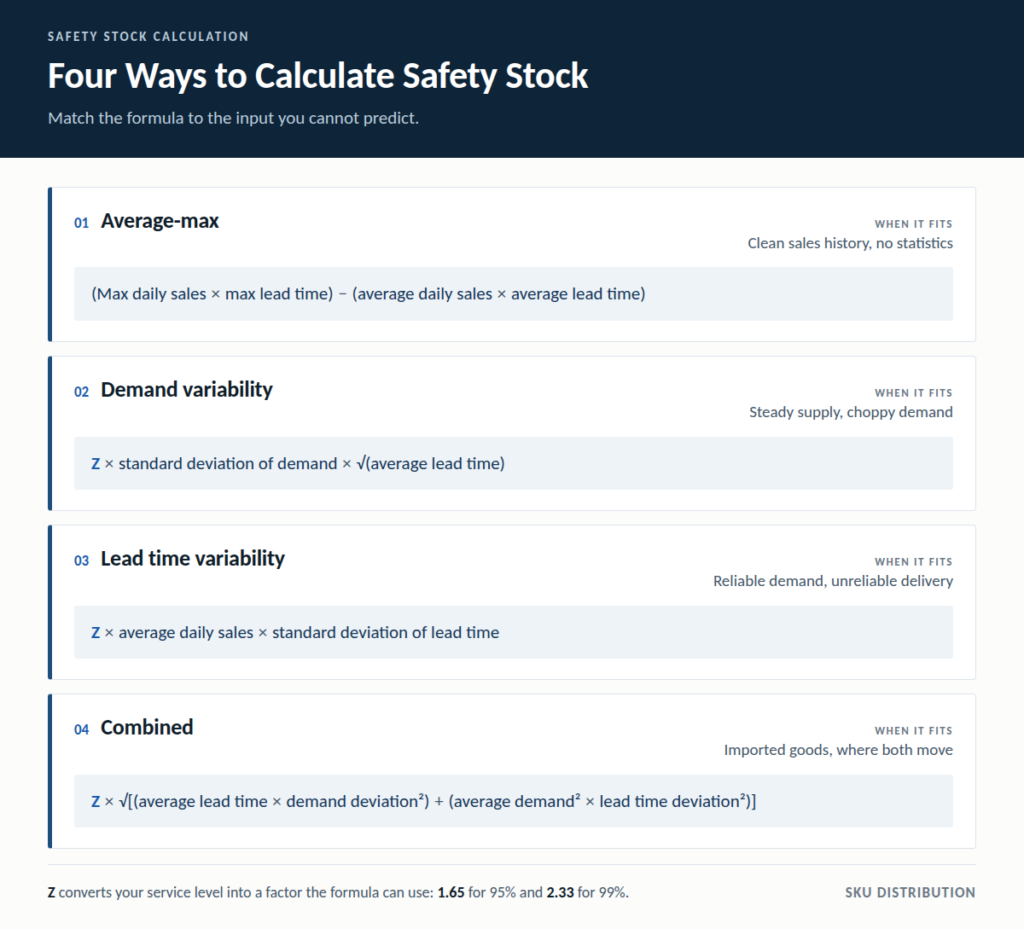
Average-max suits a SKU with clean sales history and no appetite for statistics. When demand is the unpredictable input, use the demand variability formula, and when supply is, use the lead time one. Imported goods usually need the combined version, since both inputs move. Z converts your service level into something the formula can use: 1.65 for 95% and 2.33 for 99%.
A Safety Stock Example, Run Through
Take a wellness SKU selling 120 units a day, with a demand standard deviation of 35 units and a 32-day door-to-door cycle whose standard deviation is six days. At a 95% service level:
- Demand side only: 1.65 × 35 × √32 = 327 units
- Lead time side only: 1.65 × 120 × 6 = 1,188 units
- Both inputs together: 1.65 × √[(32 × 35²) + (120² × 6²)] = 1,232 units
Run the same safety stock calculations at 99% and the requirement climbs to roughly 1,740 units. The split is the lesson: demand variability accounts for about a quarter of this buffer, and six days of slack in the supply lane accounts for the rest.
What a Buffer Costs You While It Waits
Those 1,232 units are cash in a different shape. For an importer, the bill arrives twice: once from the factory, and once from customs. Duty is no longer a rounding error. The Federal Reserve put the US effective tariff rate from recent tariff actions at 14.7% as of December 2025, 12.4 percentage points above the 2024 average.
Going from 95% to 99% protection on that SKU adds roughly 500 units, and duty on them comes due at the border months before anyone buys one.
A Foreign Trade Zone breaks that link. Stock sits here counted and pickable but not yet imported as far as customs is concerned, so the duty bill is written per unit as it leaves for a US buyer, and never at all for a unit that ships abroad. As Arizona’s first FTZ-approved 3PL, we hold the US buffer for brands like Black Crows and Gravel without them paying up front to protect a forecast.
Buy Protection In Days, Not Only In Units
Look again at where that buffer came from. Both halves of the calculation depend on lead time, so anything that shortens or steadies the clock shrinks the number you have to hold. There is not much you can do about the ocean leg. The domestic leg is another matter.
Receiving is the first place days go missing: a container that lands on Tuesday and is countable on Wednesday adds nothing to your deviation, while one that sits unchecked for a week adds to it every time. Outbound is the second. Orders leave our ecommerce fulfillment floor within 24 hours at 99.9% accuracy. That rate holds when volume doubles, because $750,000 of packing equipment sets it, not the size of the crew.
When planners doubt a count, they pad it, and padding is the most expensive safety stock there is. Our integrations team connects most storefronts and ERPs, NetSuite and SAP included, in days, so the number you reorder against is the number on the rack.
Common Mistakes When Setting Safety Stock Levels
- One service level for the whole catalog. Best sellers and slow movers deserve different answers, worked out per SKU.
- Folding promotions into the average. A promoted week is a different animal, and averaging it in hides both the spike and the ordinary week.
- Guessing the lead time deviation. Most brands know their average lead time but not how far around it their shipments actually land, and that spread swings the result hardest.
- Setting it once. A new supplier, channel, or season changes the inputs, so quarterly is the minimum.
- Treating it as a forecasting repair. Breaking into the buffer every cycle means the forecast is wrong, and a bigger buffer only delays finding out.
One more sits outside the spreadsheet: holding the buffer where it cannot legally stay. Batteries, e-bikes, and solar units need approved space, which is what our lithium-ion battery storage site is for. Supplements and beauty lines need temperature-controlled, FDA-certified racking, or a buffer held for a slow season expires before the season turns.
The Promise You Keep On A Bad Week
Safety stock is not a hedge against sloppy planning. It is the part of your inventory that decides whether a missed forecast or a late vessel becomes your customer’s problem.
You make the promises; we fulfill them. If you import, two numbers deserve a second look: the duty sitting in your buffer, and how many of those units are only there to cover a slow domestic leg. Contact us before your next purchase order goes in.
FAQ
What is safety stock, and how is it calculated?
It is the inventory held above forecast demand to cover demand spikes and supply delays. The usual approach multiplies a service level factor by the variability you are protecting against: in demand, in lead time, or in both.
What is safety stock inventory, and what is it not?
It is cover you hold on purpose, as distinct from cycle stock, which turns over with every delivery. Anything above the buffer that nobody planned for is overstock, and it behaves differently on your books.
How do you calculate safety stock when lead times vary more than demand?
Use the lead time variability method: Z × average daily sales × the standard deviation of lead time. For imported goods, the combined formula is safer still, since neither input holds still.
How to find safety stock before having a year of sales?
Borrow it. Take the demand deviation from the closest thing you already sell, pair it with your supplier’s worst quoted lead time, then recalculate after the second replenishment cycle.
Can one buffer cover both DTC and retail orders?
Yes, and it is the cheaper arrangement. One pool serving both channels needs fewer units than two pools covering the same risk, provided the floor can pick parcels and build compliant pallets off a single count, as our 3PL services do.