
A factory quote tells you what a product costs to make. What it costs to sell shows up later: in cartons nobody can scan, packaging built for a shelf rather than a parcel, or a battery shipment held up over missing paperwork.
Product sourcing covers all of it, and most of it is settled before the first unit is made. We see those decisions arrive every week at our receiving doors in Chandler, Arizona, so the second half of this guide covers the four lines worth adding to your purchase order.
TL;DR
- Product sourcing is finding, choosing, and buying the goods you sell, plus agreeing how they are made, packed, labeled, and shipped.
- Retail and ecommerce orders ask different things of a supplier, from case packs and carton labels to unit barcodes.
- China still supplies a large share of US goods, but the price that counts is the one after freight, duty, and receiving.
- The cheapest fixes go into the purchase order, where a labeling standard or a battery test summary costs the supplier very little.
What Is Product Sourcing? Where It Starts And Where It Ends
Product sourcing is the work of finding the goods you plan to sell, choosing who will supply them, and agreeing the terms they arrive on. Price and quality get most of the attention, yet the same agreement fixes how units are packed, how cartons are marked, and which documents travel with the freight.
Each of the three common sourcing routes hands you a different share of that agreement:
- Manufacturers, including private label. You set the product, packaging, and labeling standard, and you own the import. Most established brands grow into this route.
- Wholesale product sourcing. You buy finished goods from a distributor, often already in the country. It is quicker, but cartons and labels arrive the way the wholesaler ships them.
- Dropshipping. The supplier sends each order straight to your customer, so there is no stock to hold and very little say over what arrives.
Retail Product Sourcing vs. Ecommerce Product Sourcing
Sourcing product for a store shelf and for a doorstep can start at the same factory and still call for two different purchase orders.
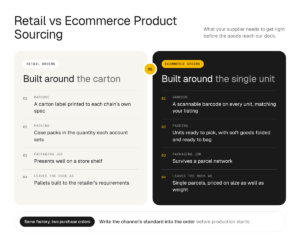
Retail product sourcing is organized around the carton. Each chain sets its own case pack, carton label, and pallet build, so the supplier has to pack for that account from the first run. REI and Backcountry are two of the accounts our retail fulfillment services ship to.
Ecommerce product sourcing is organized around the single unit, which needs its own scannable barcode and packaging that can survive a parcel network. Soft goods that arrive folded and ready to bag go straight onto our automatic bagger at around 900 units an hour. Packed loose in a master carton, the same goods need hand prep first, and that time comes out of the speed of your D2C fulfillment.
China Product Sourcing: Pricing The Unit After It Lands
US buyers imported $331.8 billion in goods and services from China in 2025, with consumer goods being the largest category at $141.9 billion, according to USAFacts. Plenty of businesses are redrawing their supplier map, though. In the Dallas Fed’s August 2025 survey of Texas executives, 23.7% of firms hurt by tariffs had already found new domestic suppliers, the same share again planned to, and 16.7% had turned to new suppliers abroad.
Wherever the factory sits, freight, duty, and brokerage land on top of the quoted price, and a new supplier adds one more risk: a first lot that does not match the approved sample. That risk is where our Foreign Trade Zone earns a place in your sourcing plan.
Freight sent to the zone can be counted and inspected on arrival, and no duty is paid on goods destroyed in the zone, according to the National Association of Foreign-Trade Zones. If part of a first run fails inspection, you’re not paying duty on units you were never going to sell. No 3PL in Arizona held that approval before we did.
What Are The Best Practices For Product Sourcing? Four Lines For Your Next Order
1) Write The Labeling Standard Into The Purchase Order
Spell out what goes on each unit (a scannable barcode matching your listing) and on each carton (SKU, quantity, and carton number), with one SKU per carton. A factory can apply all of it on the line. Cartons that arrive mixed or unmarked get opened and counted by hand before a single unit can be sold.
2) Keep The Spec In Your Own Name
If the factory is the only one holding your product spec, you start from zero when you change suppliers. Keep your own record of barcodes, materials, and packaging/carton dimensions, so a second supplier can ship to the same standard. Our integrations team then carries that item data into your store or ERP, whoever made the goods.
3) Collect Battery Paperwork Before The First Booking
Ask a supplier of anything with a lithium-ion cell for the UN 38.3 test summary and the safety data sheet while you’re still negotiating, since both get harder to obtain once the order is paid for. We are permitted for lithium-ion battery storage, so those products stay with the rest of your stock.
4) Send A Production Sample To Your Warehouse
Your team approves the sample for quality. We check whether the barcode scans and how the packaging behaves in a mailer. At the sample stage, a fix is an email to the factory. Once the container has sailed, it’s a relabeling job on our floor.
The Promise Starts At The Factory
The delivery dates you promise customers depend on decisions made in your purchase order, long before the goods ship. Get that order right, and your stock is checked in quickly when it reaches us. From there, your orders ship within 24 hours at 99.8% accuracy.
You make the promises; we fulfill them. Open the purchase order for your next production run and check two things: a labeling standard for units and cartons, and a line saying where the freight is consigned. If either is missing, bring us in at the sample stage, while the answer is still a quick change.
Contact SKU Distribution today to discuss how our FTZ status and fulfillment expertise can improve your margins and accelerate your growth.
Frequently Asked Questions
What counts as product sourcing?
Finding and choosing suppliers, negotiating price and minimum quantities, approving samples, and agreeing how goods are packed, labeled, documented, and shipped. Each repeat order counts too, as it’s a chance to change those terms.
What is the difference between retail product sourcing and ecommerce product sourcing?
It comes down to what the supplier packs for. Retail orders travel to a chain’s warehouse in full cases built to that chain’s rules. Ecommerce orders go out one shopper at a time, so each item needs its own barcode and packaging strong enough for the parcel trip. Many brands need both from the same production run.
Is wholesale product sourcing a good fit for an established brand?
It suits testing a category or filling out a range quickly, because the goods are finished and often already in the US. The trade-off is less control over packaging and labels, plus thinner margins, so many brands keep wholesale for add-on lines and source core products directly.
What should a supplier send with the first shipment?
A commercial invoice, a packing list that matches the cartons, and carton labels that correspond to the packing list. Send your warehouse an advance shipping notice before the freight arrives, so the count at the dock can be checked against it.
How do sourcing choices affect shipping costs?
Carriers price parcels on size as well as weight, so the packaging you approve at sourcing carries into every shipping rate. Our on-demand cartons are cut to fit the item, but they cannot shrink the packaging inside them.